

Year 9 & 10 students
Australian Curriculum v9.0
Geography (AC9HG9K03): Explore the environmental, economic, and technological factors that impact agricultural productivity in Australia and Asia.
Economics & Business (AC9HE9K03): Understand why Australia trades with other nations and the patterns of trade, particularly between Australia and Asia.
- This lesson is designed as a flexible tool.
- Teachers can adapt and build upon.
- 60-minute lesson.
- Stand alone.
- Customise to fit the unique needs of the classroom.
Geography, Economics & Business
AC9HE9K03, AC9HG9K03, Food Production, Geography, Economics, Agriculture, Sustainability, Trading, Vegetables
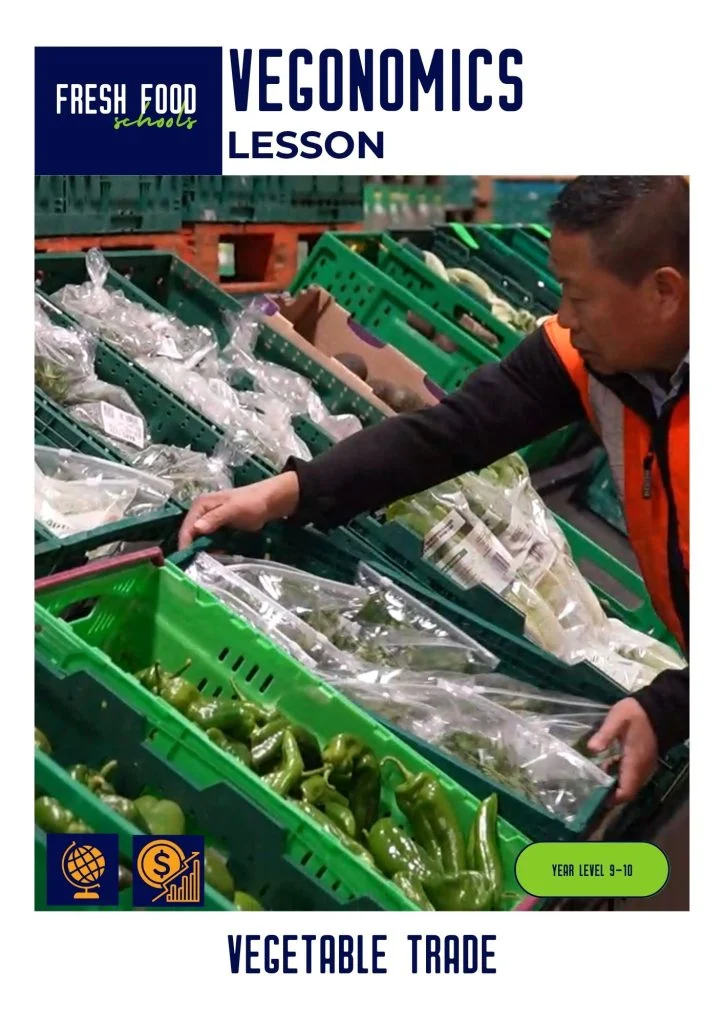
The Vegetable Trade lesson is designed to help students investigate Australia’s role in global vegetable trade, with a focus on sustainability, economic value, and international relationships—especially with Asia. It encourages students to explore trade flows, analyse vegetable-specific export data, and develop strategies to improve Australia’s export position, balancing environmental, economic, and social considerations.
Lesson Objectives
- Understand environmental, economic, and technological factors affecting vegetable production and trade.
- Interpret and analyse geographical data related to vegetable exports.
- Identify Australia’s trade relationships and challenges in the Asia-Pacific region.
- Propose strategic actions to improve sustainability and export potential.
- Develop skills in research, critical thinking, and strategic planning.
Key Concepts Taught
- Trade Geography: Understanding patterns of import/export and the geography of agricultural production.
- Agricultural Economics: Input costs, market dynamics, export pricing, and trade agreements.
- Sustainability: Sustainable farming practices, climate resilience, efficient packaging, and supply chains.
- Strategic Thinking: Designing trade strategies that balance environmental responsibility with economic growth.
- Data Literacy: Using industry reports and real-time data to inform decisions.