

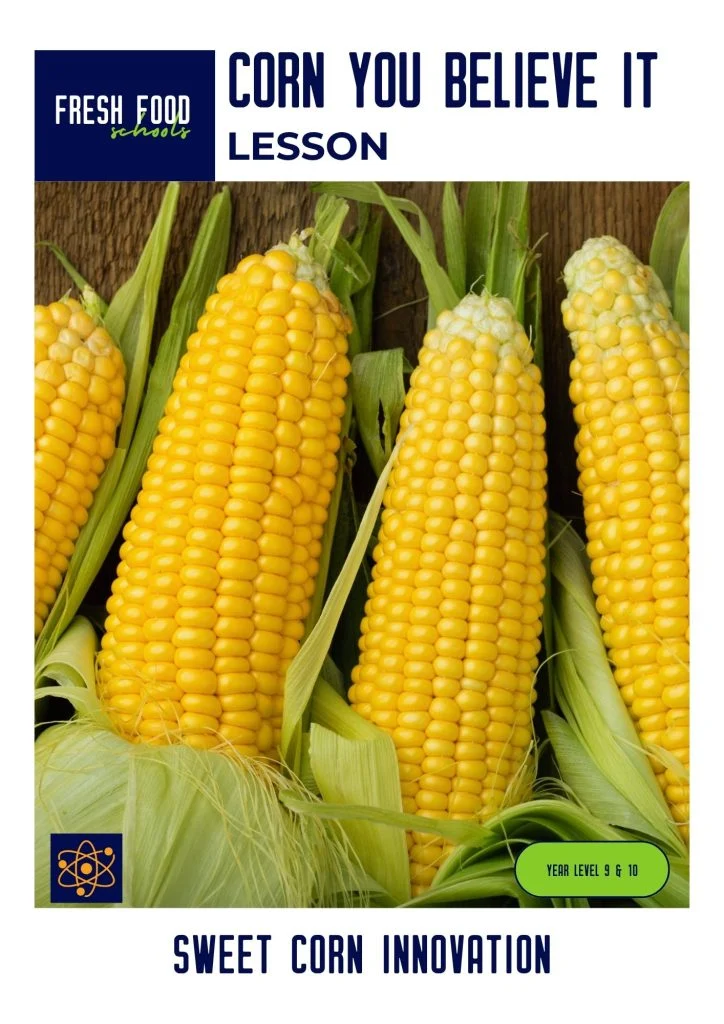
Year 9 & 10 students
Australian Curriculum v9.0
Science (AC9S9H02/AC9S10H02): Investigate how advances in technologies enable advances in science, and how science has contributed to developments in technologies and engineering.
- This lesson is designed as a flexible tool.
- Teachers can adapt and build upon.
- 60-minute lesson.
- Stand alone.
- Customise to fit the unique needs of the classroom.
Science
Sweet corn, genetics, plant breeding, agricultural science, sustainability, climate adaptation, crop innovation, food systems, practical investigation
The Sweet Corn Innovation lesson engages students with the biological, technological and climate-related factors that shape modern sweet corn production. Through hands-on investigations and critical thinking, students explore the science behind corn’s sweetness, assess how genetic traits affect consumer choices and farming practices, and analyse current innovations helping safeguard crops against climate change. The lesson connects students to the real-world applications of science and technology within Australian agriculture.
Lesson Objectives
- The science behind the sweetness of corn.
- Understand the climate change threats to sweet corn crops.
Key Concepts Taught
- Corn Genetics: Exploring the critical genetic mutations (such as su1, se1, sh2) responsible for increased sweetness in sweet corn, and the inheritance of these traits through traditional (non-GM) breeding.
- Kernels & Anatomy: Hands-on dissection of corn kernels to examine and label key parts—pericarp, endosperm, germ, tip cap—and their functions in germination and nutrition.
- Scientific Investigation: Using practical experiments to compare sugar and starch levels in sweet corn and field corn, applying methods like iodine testing and refractometry.
- Technology and Crop Improvement: Evaluating breeding strategies and technological advances that have driven innovations in sweet corn cultivation, including precision agriculture and digital monitoring.
- Climate Resilience: Identifying major climate threats (heatwaves, drought, pest pressure) to sweet corn and brainstorming adaptation solutions such as genetic innovation, irrigation management, and integrated pest management.
- Australian Industry Context: Understanding Australia’s non-GMO approach to sweet corn, the relationship between increased domestic consumption, export growth and industry sustainability.
- Critical Thinking: Discussing the impact of plant genetic techniques on food preferences, agricultural practices, societal benefits and ethical concerns.