

Years 9 & 10.
Australian Curriculum
Design & Technologies (AC9TDE10K04): Analyse and make judgements on ethical, secure, and sustainable production and marketing of food and fibre enterprises.
Design & Technologies (AC9TDE10K05): Analyse and make judgements on how the sensory and functional properties of food influence the design and preparation of sustainable food solutions for healthy eating.
- This lesson is designed as a flexible tool.
- Teachers can adapt and build upon.
- 60-minute lesson.
- Stand alone.
- Customise to fit the unique needs of the classroom.
Design and Technologies
Cucumber growth stages, Sustainable farming, Drip irrigation, Greenhouse, Sensory, Food Safety, Horticulture, AC9TDE10K04, AC9TDE10K05
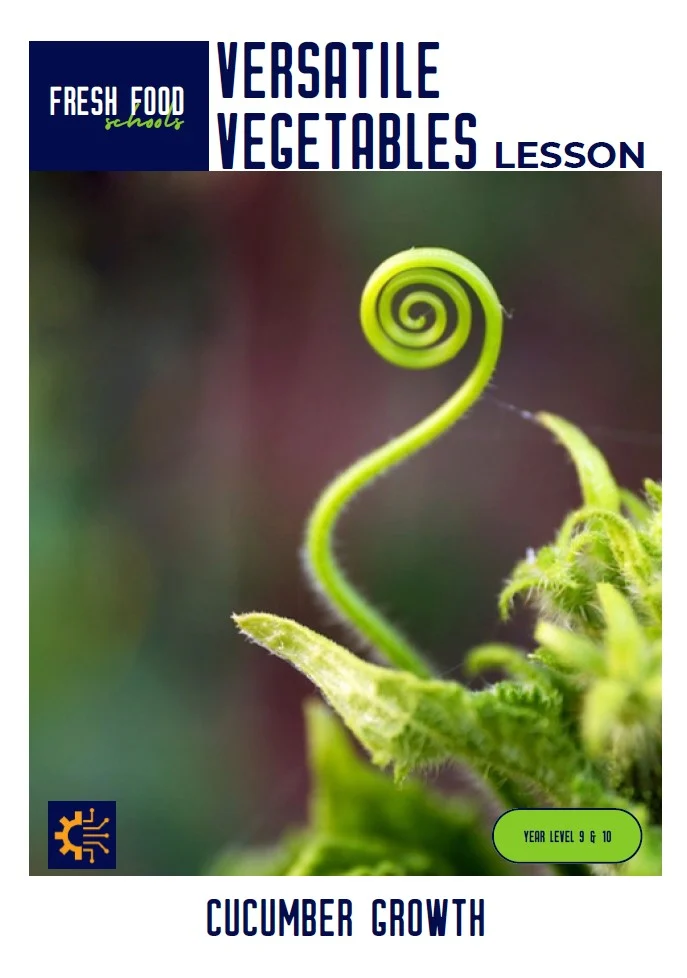
The Cucumber Growth lesson is a curriculum-aligned, interactive session designed to help students explore the life cycle, sustainable production, and consumer appeal of cucumbers in Australia’s horticulture industry. The lesson is structured to be completed in about 60 minutes and integrates background knowledge, practical group and sensory activities, case studies, and food design, offering a flexible framework for teachers to adapt to their classrooms. Students investigate the ethical, secure, and sustainable aspects of cucumber production alongside understanding sensory and functional food properties.
Lesson Objectives
- Understand how agricultural innovations and practices have
improved cucumber production in Australia. - Evaluate the ethical, secure, and sustainable production of cucumbers.
- Investigate how the sensory properties (taste, texture, appearance) and functional properties (nutrition, shelf-life) of cucumbers influence food design and preparation for healthy eating.
Key Concepts Taught
- The science of cucumber growth, including the biological stages and optimal growing conditions.
- How innovative agricultural practices (such as drip irrigation, integrated pest management, and greenhouse environments) promote water conservation, efficiency, and sustainability in cucumber farming.
- The importance of ethical and safe food production, including food safety measures, regulatory audits, and socially responsible employment.
- The impact of marketing strategies on consumer appeal, highlighting health, nutrition, and sustainability.
- How to connect visual, taste, and texture analysis of cucumbers to healthy meal design.
- Practical insights into Australia’s vegetable supply chain, food systems, and pathways to careers in agriculture and food technology.